
How to Pick the Right Size Storage Unit (A Simple Guide for Richmond, KY)
Rent a unit that’s too small and you’ll make a second trip, or leave your couch on the curb. Rent one that’s too big and you’ll pay for empty space every month. Either way, a few minutes of planning up front saves you money and stress.
The quick answer: list everything you’re storing, estimate how much space it takes (not just how many rooms you have), match it to a unit size, leave room for an access aisle, and size up if you’re stuck between two units.
Not sure which size?
This guide walks you through the method step by step, with real examples for Richmond and Madison County. For a full breakdown of each unit, see our storage unit size guide.
Quick Answer: Which Size Fits What?
What you’re storing |
Recommended |
Space |
|---|---|---|
|
Boxes, seasonal items, a few small pieces |
5×5 |
25 sq. ft. / 200 cu. ft. |
|
Studio, dorm, or small bedroom, queen mattress set |
5×10 |
50 sq. ft. / 400 cu. ft. |
|
2-bedroom apartment or a large living area |
10×10 |
100 sq. ft. / 800 cu. ft. |
|
2-bedroom home with larger furniture and appliances |
10×15 |
150 sq. ft. / 1,200 cu. ft. |
|
3-4 bedroom home, or a car, truck, or SUV |
10×25 |
250 sq. ft. / 2,000 cu. ft. |
|
4-5+ bedroom home, or a boat or large truck |
10×30 |
300 sq. ft. / 2,400 cu. ft. |
|
Large households, contractors, and business storage |
15×30 |
450 sq. ft. / 3,600 cu. ft. |
Sizes are approximate, and cubic feet assume an 8-foot ceiling. Availability varies, so call us to confirm what’s open.
Why Choosing the Right Size Matters
- Too small: You pay for a second trip or a second unit. Cramming also crushes boxes and scratches furniture.
- Too big: You pay monthly for space you never use.
- Just right: Everything stacks safely, you can reach what you need, and moving day goes smoothly.
Storage experts and customers agree on one thing: the number of rooms is only a starting point. What really matters is the number, size, and arrangement of your belongings.
Step 1: List Everything You Plan to Store
Before you look at any unit sizes, make a written inventory. This is the single most useful thing you can do.
- Go room by room. Write down every item, including the garage and attic.
- Start with the big and awkward items: sofas, mattresses, dressers, desks, appliances, bikes, and patio furniture.
- Count your boxes. Estimate small, medium, and large separately.
- Flag sensitive items: documents, photos, electronics, artwork, and wood furniture. These may need extra protection (see the climate section below).
- Note anything unusual: a motorcycle, kayak, or business equipment.
Quick tip: Use the notes app on your phone and snap a photo of each room. You’ll be glad you did when you’re estimating.
Step 2: Check Your Space at Home First
Before you rent anything, double-check what you can keep at home.
- Declutter first. Sell, donate, or toss what you don’t need. Storing less can mean a smaller unit.
- Use empty corners. A half-empty closet, attic, or garage corner may hold a few of your boxes.
- Ask whether it’s worth storing. If an item is cheap to replace and costs more to store over a long period, it may not belong in the unit. Irreplaceable things like family photos, documents, and heirlooms always do.
Step 3: Estimate Your Space Needs
There are three easy ways to estimate. Use whichever fits you.
Method A: The Pile-and-Measure Trick
Imagine (or actually stack) everything in one pile. Measure the length, width, and height of the pile.
- Square feet = length x width. A pile that’s 5 ft by 10 ft needs about 50 sq. ft.
- Cubic feet = length x width x height. This accounts for stacking.
Most units have 8-foot ceilings, so if you stack neatly you can use the height, not just the floor.
Method B: Measure Your Biggest Items First
Your largest piece sets your minimum size. Measure the length of your longest item (a sofa, dresser, or ladder). If it’s over 10 feet, a small unit is out. If you’re storing a vehicle, jump to the vehicle section.
Method C: The Everyday Comparison Tests
The couch test:
- Loveseat: fits in a 5×5, with some room for side tables.
- Standard three-seat sofa: fits in a 5×10, with room for extra furniture.
- Large sectional: fits in a 10×10, with room to spare.
The mattress test:
- Twin or full mattress: a 5×5 handles it.
- Queen mattress set: a 5×10 is the comfortable size (a 5×5 will be very tight).
The box test: A 10×15 can hold a few hundred medium boxes if packed floor to ceiling. In practice, you won’t pack that tightly if you need access. Plan on fewer boxes than the maximum.
Step 4: Match Your Items to a Unit Size
Now match your inventory to a size. Here’s what we see most often.
Small Units (5×5 and 5×10)
- 5×5 (25 sq. ft.): about the size of a large closet. It’s good for holiday decorations, seasonal clothes, sports gear, a nightstand, a twin mattress, and roughly 5-10 boxes. It’s a favorite for summer storage.
- 5×10 (50 sq. ft.): about the size of a walk-in closet. It fits a studio or dorm room: a queen mattress set, a small couch, a dresser, bikes, or a motorcycle, plus 10-20 boxes.
Medium Units (10×10 and 10×15)
- 10×10 (100 sq. ft.): roughly half of a one-car garage. It’s ideal for a 2-bedroom apartment or a large living area, including a bed, couch, TV, tables, small appliances, and plenty of boxes. It also fits ATVs and riding mowers.
- 10×15 (150 sq. ft.): comparable to a large bedroom. It works for a 2-bedroom home with a dining set, a sofa, large appliances such as a refrigerator or washer and dryer, and many boxes. It’s also popular for business inventory.
Large Units (10×25, 10×30, and 15×30)
- 10×25 (250 sq. ft.): about a large one-car garage. It holds the contents of a 3-4 bedroom home, and it’s the size to choose for a car, SUV, pickup, or small boat.
- 10×30 (300 sq. ft.): about a one-and-a-half-car garage. It holds a 4-5+ bedroom household, multiple appliances, or a full-size truck or boat.
- 15×30 (450 sq. ft.): warehouse-style space for contractors, business equipment, shelving, or very large households, with room to walk around.
Want every detail on each size? See our full storage unit size guide.
Step 5: Plan for Access and Layout
How you’ll use the unit matters as much as what’s inside it.
Ask yourself: will I visit this unit often?
- Long-term, rarely visited: pack tightly, floor to ceiling. A smaller unit may do.
- Frequent access (holiday décor, tools, business inventory, sports gear): leave a center aisle so you can reach things without unloading. That usually means sizing up.
Layout tips from the pros:
- Use uniform, sturdy boxes or plastic bins. They stack more safely.
- Put heavy boxes on the bottom, lighter and fragile ones on top.
- Stack no more than four boxes high, or place boxes on top of sturdy furniture.
- Keep items you’ll need at the front.
- Disassemble bed frames and tables to save space.
- Stand mattresses and sofas on end if the manufacturer allows it.
Between Two Sizes? Here’s How to Decide
This is the question most people get stuck on, such as a 10×10 vs. a 10×15. Use this rule:
When in doubt, go one size up. Here’s why:
- It’s much easier to enjoy a little extra room than to find on moving day that your sofa doesn’t fit.
- You’ll have room for an aisle and for safe stacking.
- You may buy or inherit more items later.
Also, a unit that’s a little bigger is sometimes available when the one you want isn’t. Give our team your inventory and we’ll tell you what’s open and what works best.
Send us your item list and we’ll tell you which unit fits.
Real-Life Examples
1. EKU student storing a dorm room for summer
A mini-fridge, a few bins of clothes, a lamp, and a desk chair. A 5×5 is usually enough. Add a mattress topper, a futon, or a TV, and a 5×10 is more comfortable.
2. A 2-bedroom apartment with a sectional
A sectional, a queen bed, a second bedroom’s furniture, a TV, and 25 boxes. A 10×10 fits if you pack carefully. If you want an aisle or have bulky appliances, choose the 10×15.
3. Home remodel in Richmond
You’re clearing out one or two rooms: couch, dresser, rugs, and boxes. A 10×10 is typical. If the kitchen is being redone and you’re storing the appliances as well, go with a 10×15.
4. Moving out of a 3-4 bedroom home
Multiple bedroom sets, living room furniture, a dining set, appliances, and boxes. A 10×25 is the right fit. For 4-5 bedrooms, step up to a 10×30.
5. A truck, SUV, boat, or business inventory
Most cars, SUVs, and pickups fit in a 10×25. For longer vehicles, boats, or trailers, choose a 10×30 or larger. See our vehicle storage options. Business owners, contractors, and anyone needing shelving or pallets should consider a 10×30 or 15×30.
6. Between homes or deployment
When your closing dates don’t line up or you’re away for a while, a unit sized to your full household (10×25 or 10×30) keeps everything safe until you’re ready.
Do You Need Climate Control, Drive-Up Access, or Vehicle Storage?
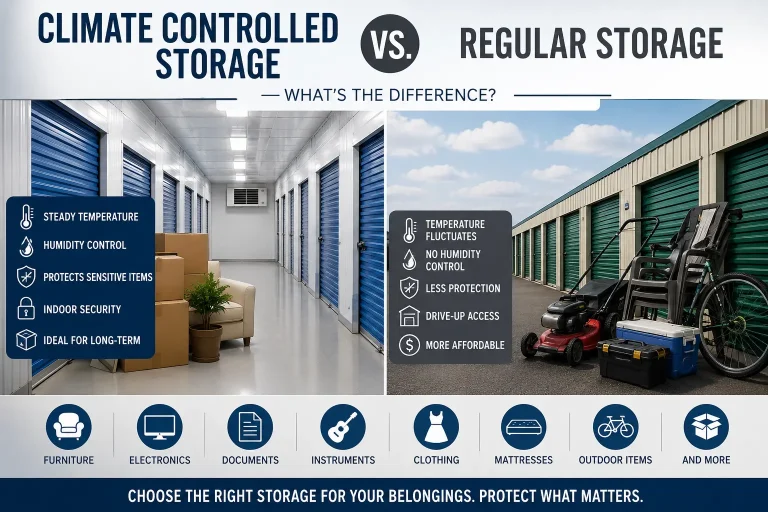
Kentucky has humid summers and cold winters. That swing can affect some belongings.
- Items sensitive to heat, cold, and humidity: wood furniture, electronics, photos, important documents, artwork, musical instruments, and leather.
- Drive-up access: convenient for heavy or bulky items, because you can park near the door and load directly.
- Vehicles and boats: consider enclosed or covered storage for long periods, especially to protect paint and interiors from sun and weather.
Not sure which features you need? Call us at +1 (859) 267-1005 and we’ll tell you what’s available.
Common Mistakes to Avoid
- Choosing by room count alone. Two homes with three bedrooms can need very different sizes.
- Forgetting the aisle. You’ll regret it the first time you need something from the back.
- Not measuring big items. A long sofa or ladder can rule out a unit.
- Using one corner for everything. Spread the weight and keep stacks stable.
- Skipping the declutter. Don’t pay to store things you’ll throw away later.
- Packing boxes of different sizes. They stack unevenly.
- Storing items that aren’t allowed, such as food, flammable liquids, or hazardous materials. Ask our team if you’re unsure.
- Waiting until moving day. Choose and reserve in advance.
Frequently Asked Questions
What size storage unit do I need for a 1-bedroom apartment?
A 5×10 usually holds the contents of a studio or small 1-bedroom. If you have a lot of furniture, a 10×10 gives you extra room.
What size storage unit do I need for a 2-bedroom apartment?
A 10×10 for most apartments, or a 10×15 if you have larger furniture or want an aisle.
What size storage unit do I need for a 3-bedroom house?
A 10×25 typically holds a 3-4 bedroom home. A 4-5+ bedroom house may need a 10×30.
What fits in a 10×10 storage unit?
Typically a queen bed, couch, dresser, TV, a few tables, small appliances, and plenty of boxes. It also fits ATVs and riding mowers.
Is a 10×10 or 10×15 better for a 2-bedroom?
A 10×10 works if you pack efficiently. Choose a 10×15 if you have a sectional, a dining set, large appliances, or want walking room.
How tall are storage units?
Most are about 8 feet tall. Height matters because it increases how much you can stack.
Will a queen mattress fit in a 5×5?
It’s very tight. A 5×10 is recommended for a queen mattress set. A twin or full fits easily in a 5×5
Can I store a car in a storage unit?
Yes. Most cars, SUVs, and pickups fit in a 10×25, and larger vehicles may need a 10×30. See our vehicle storage page.
What if I’m between two sizes?
Go one size up. You’ll have room to stack safely and reach your things.
How many boxes fit in a unit?
It depends on box size and how tightly you pack. A 5×5 holds about 5-10 boxes and a 5×10 about 10-20. Larger units hold many more, but leave room for an aisle if you need access.
Is it worth storing everything?
Compare what you’d pay over time to what it would cost to replace. Irreplaceable items always belong in storage. Cheap, bulky items might not.
Should I visit before I decide?
Yes. Looking at a real unit makes the sizes click. Our team can show you.
Ready to Choose Your Unit?
You don’t have to figure it out alone. Send us your item list and we’ll match it to the right unit, with no pressure and no confusion.